Many people assume braces are only for very crooked teeth. That’s not always the case. Sometimes the teeth look “mostly fine,” but the way they fit together tells a different story.
Generally, the decision to recommend braces usually has more to do with function than appearance. When evaluating whether someone may need braces, we look at how the bite comes together, whether certain teeth are under extra pressure, and whether alignment is making daily cleaning harder than it should be.
Do I Need Braces?
There isn’t a simple visual test for this. Two smiles can look similar and function very differently.
During an evaluation, we assess:
- Tooth alignment and spacing
- Bite relationship (occlusion)
- Jaw position and symmetry
- Oral hygiene accessibility
- Evidence of enamel wear or gum inflammation
Patients often describe small frustrations rather than major problems. Food is getting stuck in the same place. The lower front teeth look more crowded than they used to. A bite that feels “off,” even though they can’t explain why.
Teeth shift gradually over time. What feels minor now can slowly become more noticeable.
Signs You Need Braces
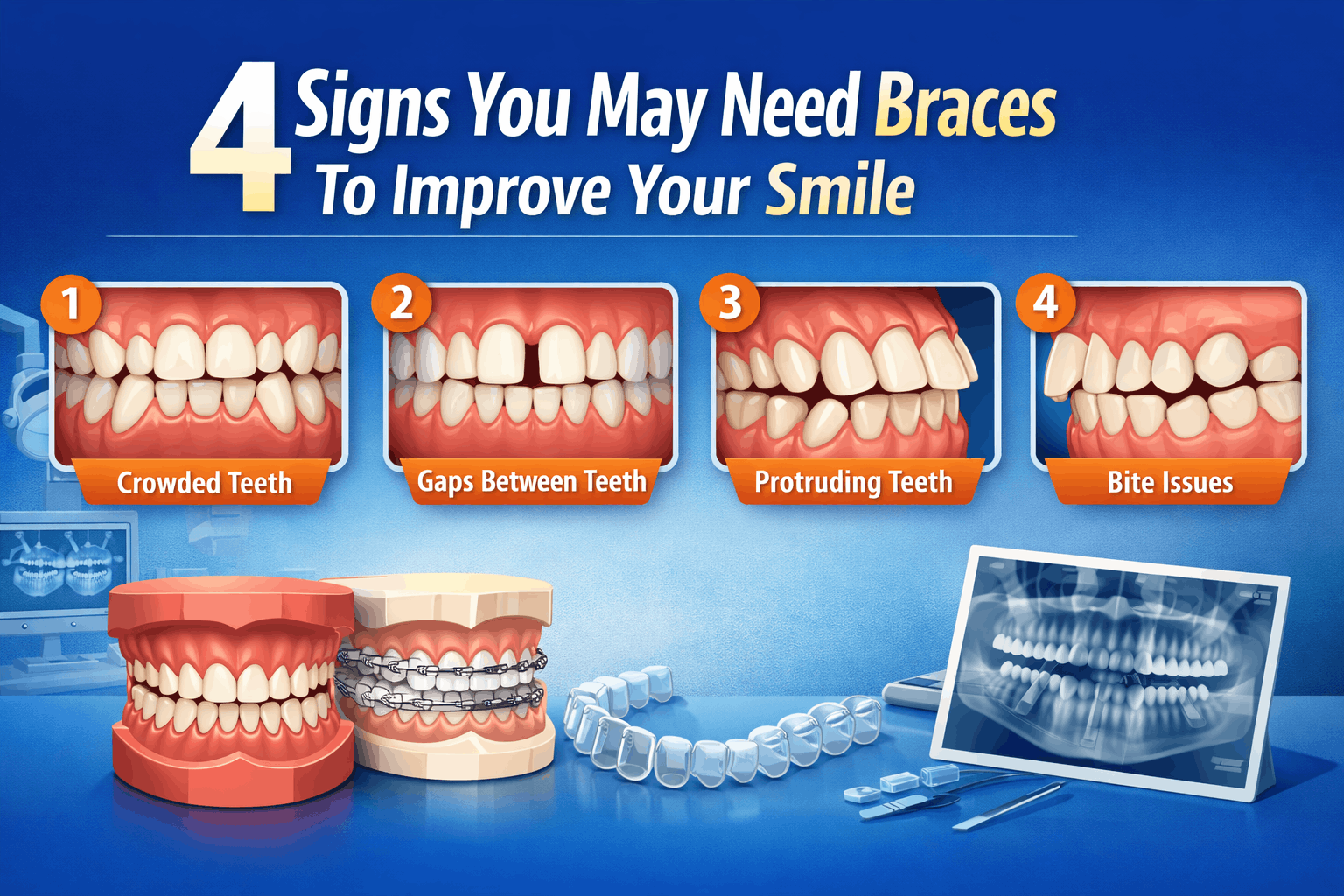
Some alignment issues are minor and stable. Others tend to progress. Below are four signs that more commonly point toward orthodontic treatment.
1. Crowded or Overlapping Teeth
Lower front crowding is probably the most common concern we see in adults.
There may simply not be enough space in the jaw. Teeth rotate a little. They overlap just enough to make flossing awkward. Over time, plaque tends to collect in those tight areas. Even people with good hygiene habits can struggle to keep themselves completely clean.
Crowding also tends to increase with age. It rarely improves on its own.
Braces create space slowly and carefully. The aim isn’t just to line teeth up for cosmetic reasons. It’s to position them in a way that makes them easier to maintain long-term.
2. Noticeable Gaps Between Teeth
Some spacing is harmless. Some isn’t.
If a gap has been stable for years and doesn’t trap food or affect your bite, it may not require treatment. But larger spaces can create bite imbalance. They can also cause food impaction or slight speech changes, especially in the front teeth.
Spacing does not usually close by itself once adult teeth are in place. Orthodontic movement is gradual and controlled, allowing the bite to stay balanced while the space is corrected.
It’s not always about how it looks. Sometimes it’s about how it functions.
3. Protruding Front Teeth
Teeth that project outward are more exposed to injury. That’s the obvious concern.
Less obvious is the reason they’re positioned that way. Protrusion often reflects the relationship between the upper and lower jaws. It’s not just about the teeth themselves.
Many patients say, “I’ve always had teeth like this.” That may be true. But if those teeth are absorbing more force than they should, or if they’re vulnerable to trauma, correction can be protective.
When braces address protrusion, the improvement is gradual. Even if the patient initially came in for cosmetic reasons, the bite often feels more balanced afterwards.
4. Bite Problems (Malocclusion)
They are often the strongest reason to consider braces.
Common types include:
- Overbite: Excessive vertical overlap of upper front teeth over lower teeth.
- Underbite: Lower teeth extend forward beyond upper teeth.
- Crossbite: Upper teeth sit inside lower teeth in certain areas.
- Open bite: Upper and lower teeth do not meet when the mouth is closed.
Pressure is not distributed evenly when the bite is uneven. Over time, this can lead to enamel wear, small cracks, gum recession, or jaw strain. Some people notice muscle tightness or clicking in the jaw joint without realizing their bite is what is contributing to it.
Braces don’t just straighten teeth. They change how teeth contact each other. The process is controlled and monitored carefully to create a more balanced distribution of force.
When Should You Get Braces? Is There A Right Age?
Children are often evaluated early. This helps in discovering and countering the developing problems, if any. But it is not just limited to teenagers.
Adults pursue braces all the time. As long as gum health and bone support are stable, age alone isn’t a barrier.
If you’re noticing teeth shifting, increasing crowding, or discomfort that wasn’t present before, it’s reasonable to have it evaluated. Earlier correction can sometimes prevent more extensive treatment later.
So, Are Braces Really Necessary?
Sometimes yes. Sometimes no.
If alignment is purely cosmetic and not affecting health or function, treatment is optional. If misalignment is contributing to cleaning difficulty, enamel wear, or jaw discomfort, it becomes preventive.
That distinction matters more than most people realize.
Clinical Evaluation and Treatment Planning
If you’re trying to figure out whether you actually need braces, it’s not something that’s decided instantly. An orthodontist doesn’t just look at your smile and make a call. They’ll check how your teeth meet when you bite down, whether certain teeth are taking more pressure than others, and how your jaw moves when you open and close.
Often, scans or X-rays are taken as well. Not for formality – but because they show things you simply can’t see from the outside. These images help reveal:
- Where the roots are sitting
- How much bone is supporting the teeth
- Whether the jaws are aligned properly
Once everything is reviewed, the conversation shifts to options. And there usually isn’t just one. Some people are better suited for:
- Traditional metal braces
- Ceramic braces that blend in more
- Clear aligners
- Or occasionally a combination, if the case is more involved
The right approach depends on what’s actually happening in your mouth, how complex the correction is, and what feels manageable in your daily life.
At the end of the day, treatment planning isn’t about choosing a device. It’s about creating a bite that functions comfortably and holds up long-term.
The Practical Takeaway
You might need braces if you’re experiencing:
- Gradually increasing crowding
- Gaps that affect chewing or trap food
- Front teeth that are exposed or prominent
- A bite that feels uneven
- Jaw clicking or muscle fatigue
But the mirror doesn’t give the full answer. A proper evaluation includes bite analysis and imaging, which reveal details that aren’t obvious at first glance.
Sometimes the recommendation is treatment. Sometimes it’s monitoring. Either way, the goal is long-term stability – not just straighter teeth.
FAQs
Are braces free in Canada?
Braces are generally not free in Canada. Provincial plans like the Ontario Health Insurance Plan (OHIP) do not cover routine orthodontic treatment. Coverage is usually limited to severe medical cases.
Most patients pay privately or use extended dental insurance. Many clinics offer payment plans.
How do I know if I need braces?
You may need braces if you have:
- Crowded or overlapping teeth
- Gaps that trap food
- An uneven bite
- Jaw discomfort or clicking
A proper orthodontic evaluation is the only way to confirm.
Do I need braces if my teeth are slightly crooked?
Not always. If mild crookedness isn’t affecting cleaning or your bite, treatment may be optional. An exam helps determine whether it’s cosmetic or functional.
What types of braces work best for adults?
Adults commonly choose:
- Metal braces
- Ceramic braces
- Clear aligners
The best option depends on case complexity and lifestyle preference.
How much do braces typically cost in Canada?
Braces in Canada typically cost between $3,000 and $8,000, depending on treatment type and case complexity. Insurance may cover part of the cost.